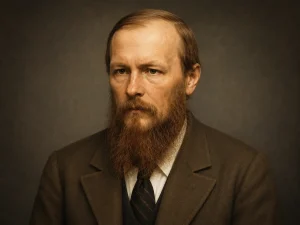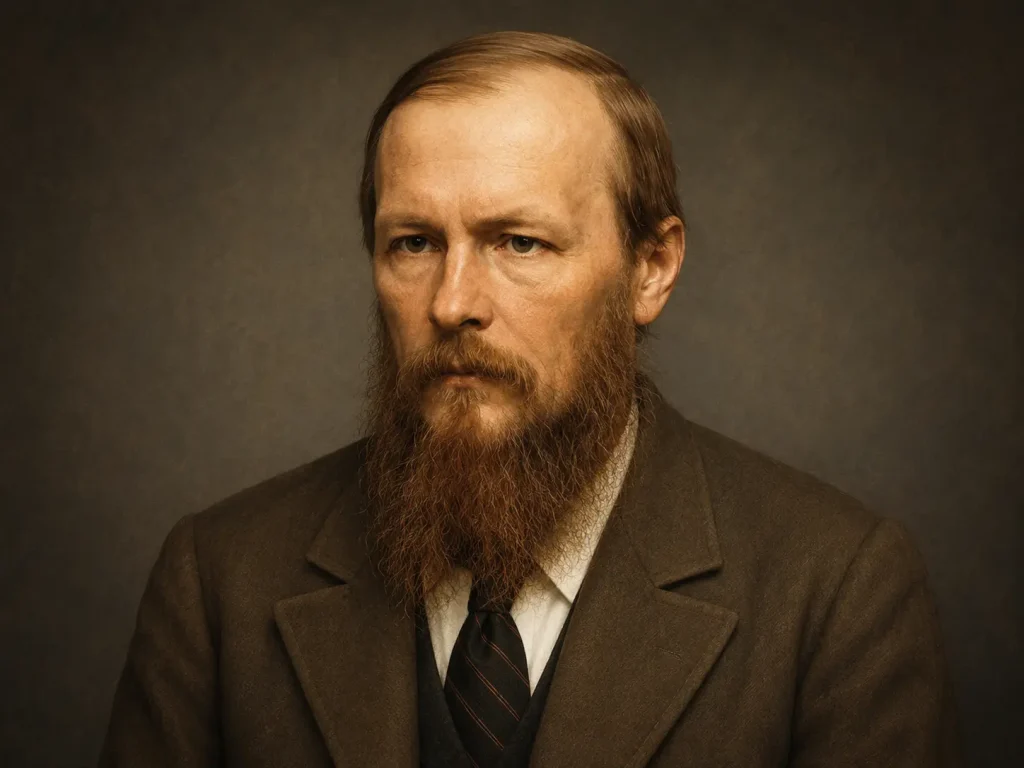
In December 1849, Fyodor Dostoevsky stood before a firing squad in Saint Petersburg. He had been arrested for participating in a political discussion group considered dangerous by the Russian government.
The order to execute him had already been read.
Just moments before the sentence was carried out, a messenger arrived with unexpected news. The execution was canceled. Instead, Dostoevsky would spend years in a Siberian prison camp.
That brush with death changed him forever.
It also shaped the way he viewed faith, suffering, human nature, and ultimately, art itself.
Years later, Dostoevsky wrote that art had never abandoned humanity, that it had always answered human needs and ideals, and that it had helped people search for those ideals throughout history.
More than a century later, those words remain remarkably relevant.
Who Was Fyodor Dostoevsky?
Fyodor Dostoevsky (1821–1881) was one of the most influential writers in world literature.
Born in Moscow, he became famous for exploring the deepest psychological and moral questions facing human beings. His novels, including Crime and Punishment, The Brothers Karamazov, and The Idiot, continue to be studied around the world.
Unlike many intellectuals of his era, Dostoevsky’s ideas were not formed in comfortable lecture halls alone. They were shaped by imprisonment, poverty, illness, and personal tragedy.
Those experiences convinced him that human beings need more than material success. They need meaning.
The Historical Context Behind the Quote
The nineteenth century was a period of rapid transformation.
Russia was changing. Industry was expanding. New political ideologies were spreading. Scientific discoveries challenged traditional beliefs about religion and society.
Many thinkers believed reason alone could solve humanity’s problems.
Dostoevsky was not so sure.
He feared that a society focused only on progress and efficiency might lose sight of deeper human needs—compassion, morality, beauty, and spiritual purpose.
That concern lies at the heart of his reflections on art.
What Did Dostoevsky Mean?
When Dostoevsky said that art has never abandoned humanity, he was pointing to something visible throughout history.
Every civilization has created stories, songs, paintings, sculptures, and myths.
Ancient Egyptians decorated tombs with elaborate artwork. Greek poets preserved cultural memory through epic stories. Medieval artists filled churches with images designed to inspire faith.
The forms changed, but the impulse remained.
Human beings consistently create art because they are searching for meaning.
For Dostoevsky, art was not a luxury reserved for wealthy societies. It was a basic human need.
Why Art Matters More Than Entertainment
Entertainment provides enjoyment.
Art can provide transformation.
That distinction was important to Dostoevsky.
A great novel can challenge deeply held beliefs. A piece of music can express emotions that words cannot capture. A painting can force viewers to see the world differently.
These experiences remain with people long after the moment passes.
Great art does not simply help people escape reality. It helps them understand reality.
Why This Message Still Matters Today
Modern audiences consume more content than any previous generation.
Videos, social media posts, podcasts, articles, and streaming platforms compete constantly for attention.
Most of it disappears from memory within hours.
Yet people continue returning to great books, films, music, and works of art created decades—or even centuries—ago.
Why?
Because technology changes faster than human nature.
People still struggle with loneliness, purpose, morality, identity, love, and loss. They still search for answers to questions that cannot be solved by algorithms or statistics.
That is why Dostoevsky’s observation continues to resonate.
A Timeless Reminder About What Makes Us Human
Dostoevsky believed art grows alongside humanity because it responds to something permanent within human nature.
People do not live by facts alone.
They need stories.
They need beauty.
They need ideals worth pursuing.
They need ways to understand suffering and hope.
More than a hundred years after his death, Dostoevsky’s words still remind us that art is not merely decoration or entertainment. It is one of humanity’s oldest tools for making sense of the world.
As long as people continue searching for truth, meaning, and purpose, art will remain what it has always been: a faithful companion on that journey.